
Finding a tenant isn’t difficult. Finding the right tenant — someone who pays on time, takes care of the property, and communicates well — is where experience and process matter.
That’s where a strong tenant screening process comes in.
Whether you’re self-managing or working with a Memphis property management company, understanding how tenants are evaluated can help you protect your investment and avoid costly issues down the line.
What Makes a Good Tenant?
A “good tenant” isn’t just someone who gets approved. It’s someone who consistently meets expectations throughout the lease.
Typically, strong tenants demonstrate:
- Reliable, verifiable income
- A history of on-time payments
- Positive rental history
- Respect for the property
- Clear and consistent communication
No screening process is perfect, but looking at the full picture — not just one data point — leads to better outcomes.
Why Tenant Screening Matters
Tenant placement is one of the most important decisions in the lifecycle of a rental property. The right tenant can lead to:
- On-time rent payments
- Fewer maintenance issues
- Longer lease terms
- Less stress overall
The wrong tenant can result in:
- Late or missed payments
- Property damage
- Lease violations
- Potential eviction
A structured tenant screening process helps reduce these risks and creates more predictable, stable performance over time.

What Does the Tenant Screening Process Include?
A professional tenant screening process evaluates multiple factors together — not just credit score alone.
Credit History
Credit provides insight into how an applicant has handled financial obligations in the past. While there’s no single “perfect” number, patterns matter, including payment history, outstanding debt, collections or charge-offs, and balances due to former landlords.
Credit is one piece of the puzzle, but it’s not the entire decision.
Income & Employment Verification
Applicants should demonstrate the ability to comfortably afford the rent. This typically includes:
- Income verification (pay stubs, offer letters, etc.)
- Employment confirmation
- Income-to-rent ratio analysis
At 901 Real Estate Services, we require income of at least three times the monthly rent. While some screening standards use lower thresholds, we’ve found that a 3x income ratio provides a more comfortable margin for residents — allowing them to manage rent alongside everyday expenses without becoming financially strained.
This approach not only helps reduce the risk of late payments, but also supports a more stable and positive rental experience over the course of the lease.
Stable, sufficient income is one of the strongest indicators of long-term success for both the resident and the property owner.
Rental History
Past behavior is often the best predictor of future behavior. Residential history screening may include previous landlord references, payment history, lease compliance, and any prior evictions.
At 901 Real Estate Services, we go a step further by contacting previous landlords whenever possible to gain a clearer understanding of an applicant’s rental history.
These conversations typically focus on:
- Whether rent was paid on time
- How the property was maintained
- Whether pets were present and properly disclosed
- If appropriate notice was given prior to move-out
This additional context helps us move beyond what’s listed on paper and better understand how an applicant has performed in a real-world rental setting.
We also place a strong emphasis on verification throughout the process.
When reviewing applications, we take steps to confirm that contact information provided for employers and previous landlords is legitimate and consistent with known business practices. In today’s rental environment, it’s increasingly important to verify that application details are accurate. When something appears inconsistent or incomplete, we take additional steps to confirm information through reliable sources.
These extra layers of diligence help reduce the risk of misrepresentation and contribute to more informed, confident leasing decisions.
Background Checks
Background screening helps identify potential risk factors. These screening steps typically include a criminal background check (as permitted by law), as well as eviction history.
But a thorough screening process doesn’t rely solely on automated reports.
In some cases, court filings or recent activity may not yet appear in standard screening results. That’s why an additional layer of verification — such as reviewing local court records — can provide a more complete and current picture of an applicant’s history.
Verification Matters: Going Beyond the Basics
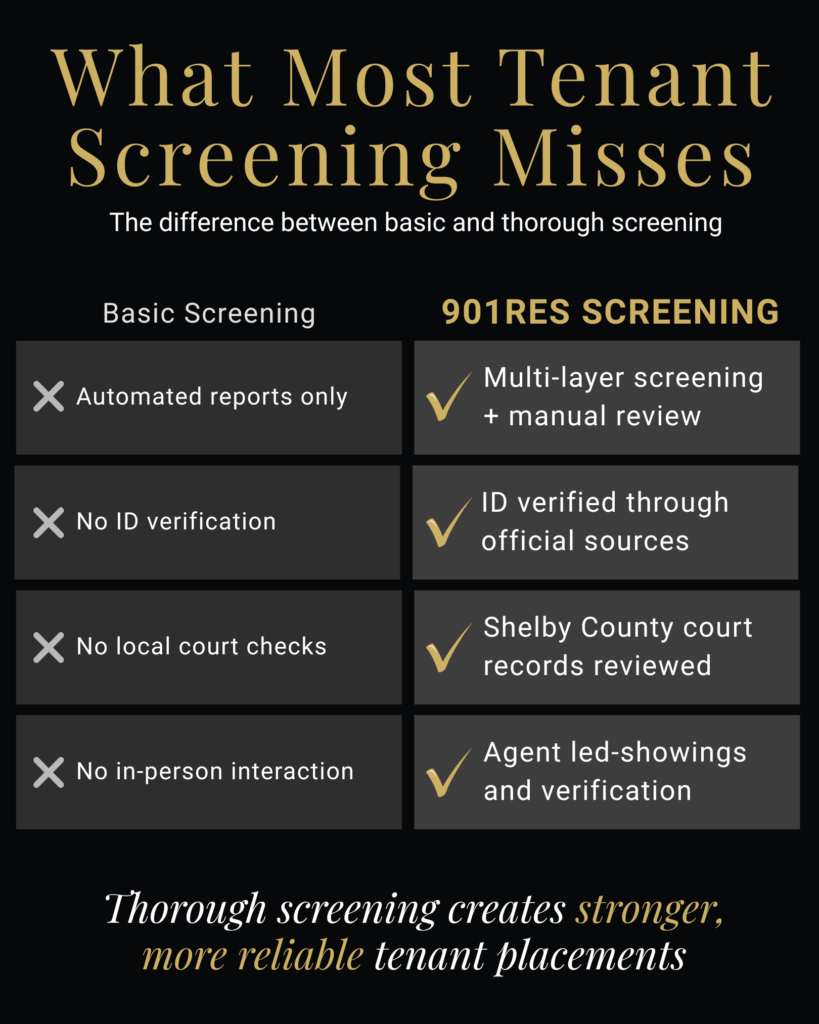
Not all tenant screening processes are created equal. Many systems rely heavily on automated reports. While those are helpful and a good basis for initial screening, they don’t always tell the full story.
At 901 Real Estate Services, we take a more thorough, hands-on approach to tenant screening.
In addition to standard screening tools, we verify identification through official state resources whenever possible, helping ensure that the applicant is who they say they are.
We also review local court records — including Shelby County filings — to check for recent activity that may not yet appear on standard background reports. This provides a more complete and up-to-date picture of an applicant’s history.
There’s also value in simply meeting applicants in person. That’s one of the reasons we only have agent-led showings. Not only does this create a better experience for prospective residents, but it also allows us to:
- Confirm that the individual touring the home matches the application and ID
- Answer questions in real time
- Identify potential inconsistencies early in the process
These additional layers of verification help reduce fraud, prevent surprises, and ultimately lead to stronger, more reliable tenant placements.
Consistency Matters More Than Perfection
One of the biggest mistakes in tenant screening is inconsistency. Approving one applicant under one set of standards and another under different criteria can lead to:
- Increased risk
- Compliance issues
- Unpredictable outcomes
At 901 Real Estate Services, we apply the same clearly defined screening criteria to every application and maintain internal alignment across our team to ensure decisions are consistent, documented, and compliant.
Tenant Screening in Memphis, TN
In a market like Memphis, tenant screening plays an even more important role. With higher vacancy rates and a wide range of rental inventory, it can be tempting to prioritize speed over quality — but that often leads to problems later.
Balancing speed and standards is key:
- Moving quickly to secure a qualified applicant
- Without compromising on screening criteria
A local Memphis property management team understands how to strike that balance — and when to dig deeper to protect the property.
How Property Managers Approach Tenant Screening
Professional property managers don’t just “check boxes” — they follow a structured system.
That typically includes:
- Standardized criteria applied to every applicant
- Clear documentation of decisions
- Communication with applicants throughout the process
- Alignment across the team to ensure consistency
At 901 Real Estate Services, that system combines technology, local knowledge, and hands-on verification — not just automated approvals. Because when screening is done thoroughly on the front end, everything that follows tends to run more smoothly.
Final Thoughts
So, what makes a good tenant? It’s not just a credit score or an income number — it’s the full picture.
A strong tenant screening process looks at financial stability, rental history, and overall reliability to make informed, consistent decisions. And when done well — with both technology and thoughtful, hands-on verification — it sets the foundation for a smoother, more successful rental experience.
Have Questions About Tenant Screening?
If you’re evaluating applicants or wondering how your current process compares, it can be helpful to talk through your approach. Tenant screening is one of the most important parts of property management — and getting it right makes everything else easier.