

Most renters are not seriously searching months before they plan to move. Understanding when renter demand becomes active helps us decide when to launch a listing, how to price it, and why preparing the property early matters.
It is easy to assume that the earlier a rental property is listed, the better. More days online should mean more chances to find a tenant.
But renter behavior does not always work that way.
Most renters become serious about their search relatively close to their intended move date. That means the goal is not simply to have a property online for as long as possible. The goal is to have it positioned well when the renters most likely to lease it are actively looking.
The Serious Search Window Is Shorter Than You Might Think
Apartments.com reports that the average rental search lasts about 27 days, while 63% of renters expect their search to take two months or less. More than 60% also expect to seriously consider only two or three properties.
RentCafe recommends renters begin actively looking about 30–60 days before their intended move, and Zillow advises renters to narrow their search and get serious about two months before moving.
That does not mean renters never browse earlier. They do. But browsing and being ready to apply are not necessarily the same thing.
This is why listing a property 90 or 120 days before it is available does not automatically create an advantage. Many of the renters seeing it that early may need housing much sooner, while the renters whose timing actually matches the property may not have started seriously searching yet.
Active Renters Tend to Move Quickly
Once a renter finds a property that fits their needs, the next step often happens quickly.
RentEngine data has shown that showing completion drops significantly when tours are scheduled too far in advance, falling below 50% once the wait stretches beyond roughly a day or two.
That means it is not enough for a property to simply be listed. It also needs to be ready to show when active renters find it.
If someone is ready to move now, asking them to wait two or three weeks for a showing gives them plenty of time to choose something else.
Preparation Starts Before the Tenant Moves Out
Waiting to list does not mean waiting to work.
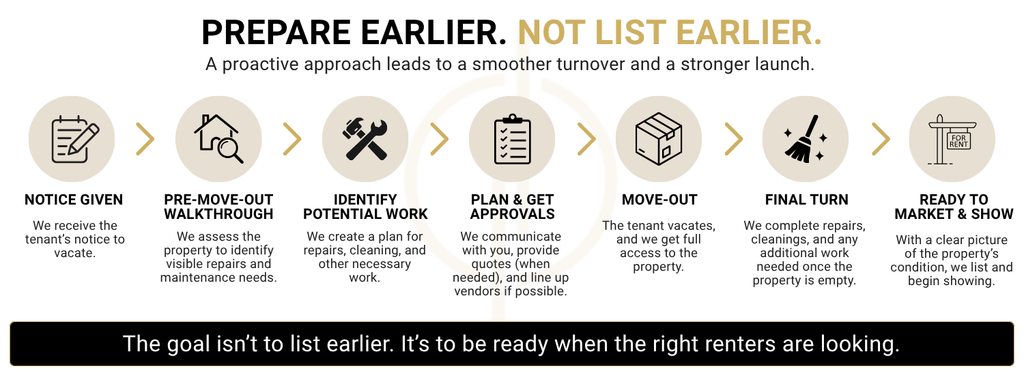
When a resident gives notice, we begin preparing well before the property is vacant. One of the first steps is a pre-move-out walkthrough, which gives us an opportunity to identify visible repairs, maintenance issues, or other work that may need attention once the resident leaves.
That allows us to start planning, communicating with the owner, and, when appropriate, coordinating vendors before the turnover clock officially begins.
We may not be able to identify or complete everything while the resident is still occupying the property. Some damage, cleaning needs, or maintenance issues are only fully visible once the home is empty. But getting an early look helps us anticipate the work ahead and reduce surprises after move-out.
The strategy is not to list earlier. It is to prepare earlier.
Why We Typically Do Not Show Occupied Properties
That preparation does not necessarily mean we should begin showing the property while the current resident is still living there.
Showing an occupied property often requires coordinating around the resident’s schedule, notice requirements, pets, work hours, and other logistics. That can make it difficult to offer the quick showing times serious renters often expect. If a prospect has to wait several days for access, they may simply move on to another property.
There is also the issue of property condition. Even after a pre-move-out walkthrough, we may discover additional repairs, cleaning needs, or damage once the resident leaves and the home is empty. If we begin showing too early, we risk creating expectations about a move-in date before we know exactly what work will be required.
That can lead to delays, changed availability dates, or frustration for a renter who was expecting the property to be ready sooner.
Our preference is to prepare as much as possible before move-out, then market and show the property once we have a clearer picture of its condition and readiness.
What Memphis Days of Market Tell Us
Zillow currently reports that single-family rental houses in Memphis average 59 days on market. That is an average, not a prediction for every property.
Not every rental is competing for the same group of renters. Price is one of the biggest factors that determines the size of the renter pool, but it is not the only one. Pet policies, included appliances, parking, location, bedroom count, property condition, and other features can all narrow — or expand — the number of renters who may consider a particular property.
That is why the 59-day average should be viewed as context, not an expectation.
We regularly see properties enter the market at a competitive price, generate strong activity quickly, and receive multiple applications. Those properties are often well-positioned from the beginning and available when active renters are ready to make a decision.
Other properties may take longer because the potential renter pool is smaller or the timing is less favorable.
The goal is not to assume a property will take 59 days to lease. It is to understand the market we are entering and make sure the property is ready when the right renters are looking.
The Bottom Line
A successful leasing strategy is not about maximizing the number of days a property is advertised. It is about understanding renter behavior and preparing accordingly.
We want to get ahead of the turnover, identify potential repairs, minimize unnecessary delays, and bring the property to market when it is ready to show and the most relevant renters are actively searching.
Prepare early. Price strategically. Launch when the renters are ready.