

Waiting can feel like the cautious choice, especially when a decision involves money. But in property management, waiting is not always neutral.
Not every decision needs to be rushed, but timing matters. When we make recommendations about repairs or next steps, our goal is not to pressure owners into spending money unnecessarily. Our goal is to help owners understand the trade-offs before a small delay becomes a larger expense.
Delayed Repairs Can Cost More Than the Repair
When a repair request comes in, it can be tempting to focus only on the invoice. But the cost of waiting is often bigger than the repair itself.
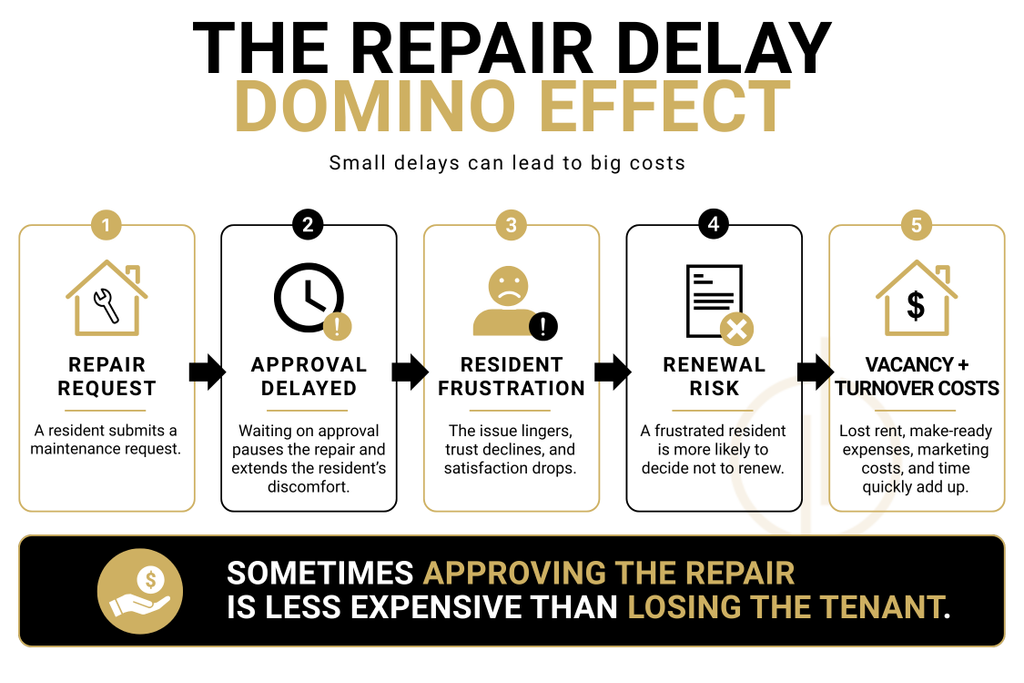
If a resident is dealing with a broken appliance, unresolved leak, HVAC issue, or another problem that affects their ability to comfortably live in the home, slow approvals can quickly create frustration. Even strong residents are less likely to renew if they feel their concerns are ignored or basic repairs are delayed.
Sometimes approving the repair is less expensive than losing the tenant.
A lost renewal can mean vacancy, turnover repairs, cleaning, utilities, marketing time, and leasing costs. In many cases, the faster and more financially responsible decision is to address the issue promptly, protect the resident relationship, and keep the property performing.
Repairs can also create legal, financial, and practical risk when they are not handled appropriately. Under Tennessee law, landlords have obligations to maintain rental property and make repairs necessary to keep the premises fit and habitable. For certain essential services, failure to respond after proper written notice can give residents legal remedies. That is one reason we take reported repair issues seriously and push for timely decisions when owner approval is needed.
Even when an issue is not an emergency, delays can still create problems. A minor leak can become water damage. An appliance issue can become a resident complaint. A slow approval can make a resident feel ignored. A repair that could have been handled calmly can become a source of tension for everyone involved.
When we recommend moving forward with a repair, we are not simply trying to spend owner money. We are often trying to prevent larger expenses, protect the resident relationship, and keep the property in compliance with the owner’s responsibilities.
A Delay Can Be Longer Than It Looks
Approving a repair a few days later does not always mean the repair happens only a few days later. Vendors schedule around existing appointments, parts may need to be ordered, and other work may depend on that repair being completed first. A decision delayed until Friday may not move forward until the following week.
During a turnover, that can affect cleaning, painting, inspections, photography, or the date the property is ready for its next resident.
In property management, a small delay at the beginning of the process can create a much larger delay at the end.
A Delayed Decision Can Slow Everything Down
Property management often involves several moving pieces. Our team can gather information, communicate with residents, coordinate vendors, request estimates, and make recommendations, but when owner approval is required, the process cannot move forward without a response.
That is why we try to communicate clearly when something needs an owner’s attention. Waiting on a repair approval can increase resident frustration, delay vendor scheduling, or turn a relatively simple issue into a larger one. During a vacancy or turnover, delayed decisions can also push back the work that needs to happen before the property is ready for its next resident.
A timely decision does not always mean saying yes to everything. It means reviewing the recommendation, understanding the trade-off, and making an informed decision before delay becomes its own cost.
The Bottom Line
Our job at 901RES is not just to report problems. It is to help owners understand the trade-offs behind each decision and what those decisions may cost if they are delayed.
Waiting can feel like the safest or most economical option, especially when an unexpected expense is involved. But sometimes the larger cost is what happens next — additional damage, resident frustration, a lost renewal, or a longer and more expensive turnover.
Our goal is to provide the information, context, and experience needed to make the best decision possible. Sometimes spending a little more today prevents a much larger expense tomorrow.
The right decision at the right time can make all the difference.
The Data Behind the First Seven Days
Last month, we talked about why the first seven days of a rental listing matter — and why pricing, presentation, and timing are especially important when a property first hits the market.
New mid-year rental data is reinforcing that message.
The Data Is Backing It Up
According to ShowMojo’s Q2 2026 leasing data, the South saw 8.7% more leads per home than a year ago, but fewer of those inquiries converted into scheduled showings. Inquiry-to-showing conversion fell 5.8 percentage points, while average rents in the region were down 3.9% year over year. Even with more prospective renters looking, 25.5% of Southern listings ultimately needed a rent reduction.
Vanessa Anderson, CEO of ShowMojo, recently stressed that seven days is enough time to know whether a listing is getting the response it should. If leads and showings are weak after that first week, it’s time to make a pricing decision — and make it quickly.
Rentometer is seeing a similar trend. During the first half of 2026, median asking rents for three-bedroom single-family homes fell 1.6% nationally and 2.9% in the Southeast. Nearly half of the 1,099 markets they analyzed saw rents decline from last year.
The issue isn’t necessarily a lack of renters. It’s competition.
Renters have more choices, including new apartments, build-to-rent communities, and single-family homes that might otherwise have been listed for sale. Many competing properties are also offering concessions such as free rent or discounted move-in costs.
That makes the beginning of a listing even more important. A property can receive plenty of online interest and still struggle if renters see a better value elsewhere. More leads don’t automatically mean the asking price is working.
Our goal isn’t to chase the lowest rent. It’s to position each property competitively from the start, watch how the market responds, and make informed adjustments before unnecessary vacancy begins costing more than the adjustment itself.